602.224.0598
Mon - Fri 8:30 AM - 4:00 PM
3426 E. Shea Boulevard, Phoenix, Arizona 85028
RESOURCES
Desert Voices School
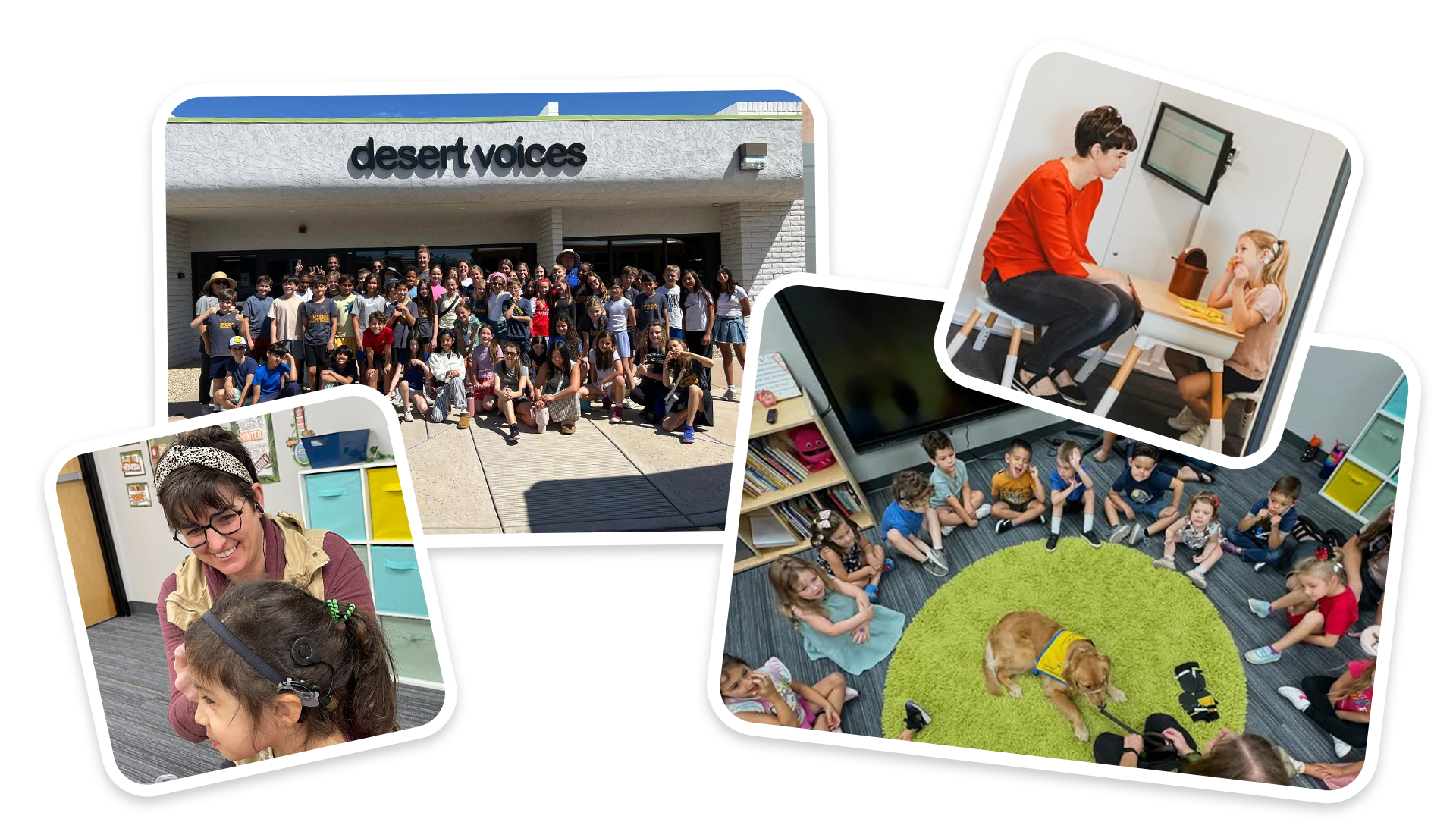
Desert Voices Oral Learning Center has taught deaf and hard-of-hearing children to listen and speak since 1996, serving infants through age five or six with a two-to-three student-to-teacher ratio. Our pediatric audiology clinic operates on the same campus, allowing us to serve even more children in the Phoenix and surrounding area. Visit Desert Voices school.
Appointment Preparation
Make your child’s hearing test experience smooth and worry-free with our easy-to-read preparation guides. Learn what to expect during BAER, VRA, CPA, and Conventional hearing tests so you can come prepared and confident. Download both guides below.
Audiology 101
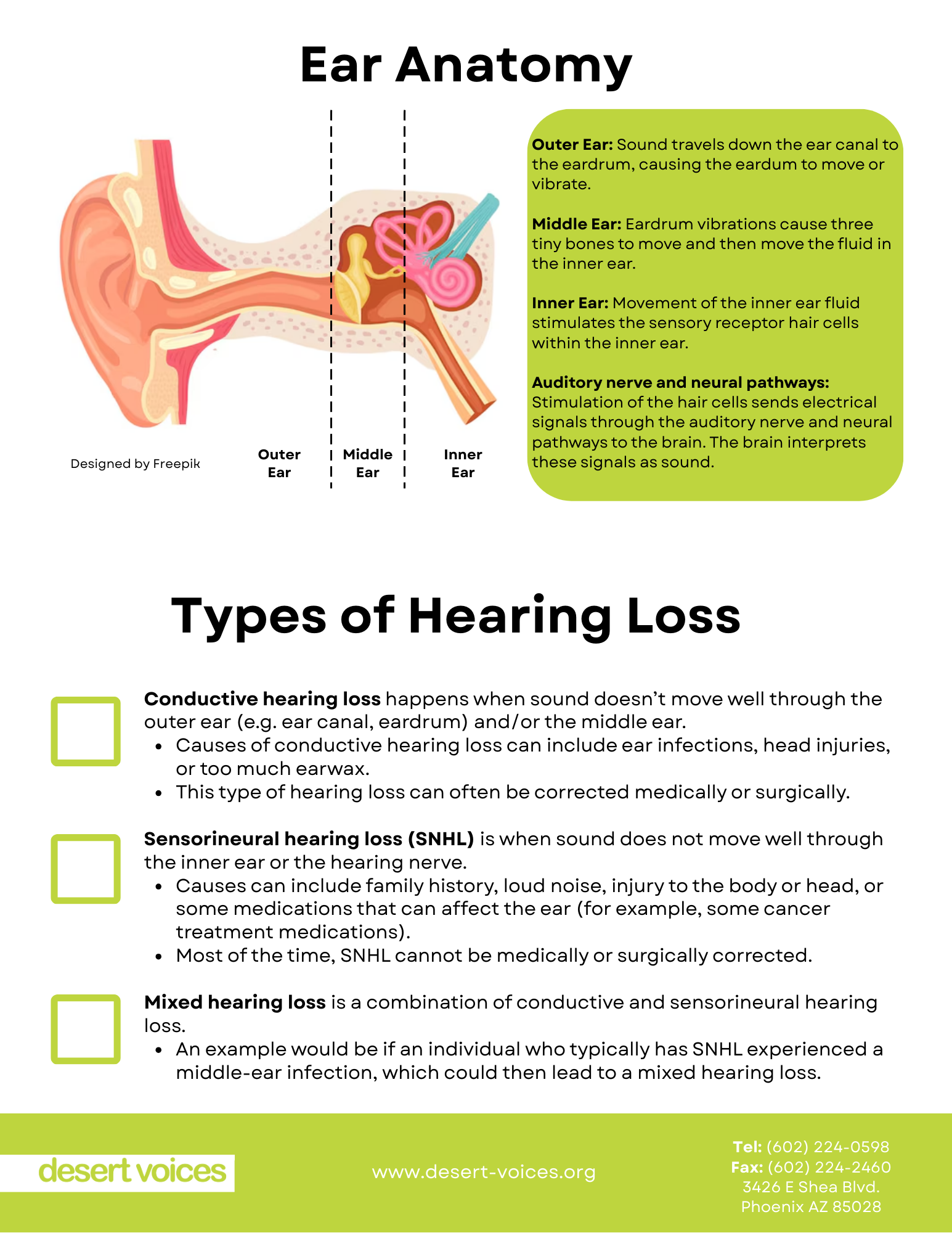
How Hearing Works
Sound enters the outer ear, vibrates the eardrum, passes through three tiny bones in the middle ear, and reaches the cochlea (inner ear) — which converts vibrations into electrical signals the brain understands as sound.
What Is Hearing Loss?
Hearing loss means part of this system isn't working as expected. It ranges from mild (missing soft sounds or struggling in noisy rooms) to profound (little access to sound without devices). It can be present at birth or develop later, and can affect one or both ears.
Types of Hearing Loss
Conductive — Sound can't travel efficiently through the outer or middle ear. Often caused by fluid or infection, and frequently treatable.
Sensorineural — The inner ear or auditory nerve isn't functioning typically. This is the most common permanent hearing loss in children, managed with hearing aids or cochlear implants.
Mixed — A combination of both.
How Is It Detected in Children?
For babies, audiologists use OAE and ABR tests that measure the ear's response to sound during natural sleep — no participation needed. For older kids, behavioral tests use tones and speech through headphones or speakers, adapted to your child's age.
Why Early Detection Matters
The first three years are critical for speech and language development. Children identified early and fitted with appropriate technology have significantly better outcomes in spoken language, reading, and school performance. Arizona EHDI guidelines recommend screening by one month, diagnosis by three months, and intervention by six months.
Ear Anatomy & Hearing Loss Checklist
Use this downloadable checklist with the diagram to identify potential hearing loss in your child. Mark symptoms you observe and share with Desert Voices for expert guidance.
Audiology Terms
ABR (Auditory Brainstem Response) — Measures how a child's auditory nerve responds to sound using small electrodes on the head. Common for newborns and infants.
BAER (Brainstem Auditory Evoked Response) — Another name for ABR. We perform natural-sleep BAER studies without sedation.
Audiogram — A chart showing your child's hearing across different pitches and volumes — the primary tool for describing hearing loss.
Behavioral Audiometry — Tests where a child responds to sounds by turning, raising a hand, or completing a play task. Technique varies by age.
BAHD (Bone-Anchored Hearing Device) — Sends sound through the skull directly to the inner ear. Used for conductive or single-sided hearing loss.
Cochlear Implant — A surgically placed device that stimulates the auditory nerve directly. For children with severe to profound hearing loss who get limited benefit from hearing aids.
Conductive Hearing Loss — Sound can't reach the inner ear efficiently, often due to fluid, infection, or structural differences.
CPA (Conditioned Play Audiometry) — Hearing test for kids roughly two to five. The child does a play action (like dropping a block) each time they hear a sound.
Decibel (dB) — Unit of loudness. Normal conversation is about 60 dB. Hearing loss ranges: mild (26–40), moderate (41–55), severe (71–90), profound (91+).
Frequency (Hz) — The pitch of a sound. Hearing loss can affect some pitches more than others, which is why your child may hear some sounds but miss others.
HAT (Hearing Assistive Technology) — Devices like remote microphones that send a speaker's voice directly to your child's hearing aid or implant. Widely used in classrooms.
Hearing Aid — A device worn behind the ear that amplifies sound. Most children use behind-the-ear (BTE) models with custom earmolds.
OAE (Otoacoustic Emissions) — A quick test measuring sounds the inner ear produces in response to tones. Used for newborn screening and comprehensive evaluations.
Otoscopy — A visual check of your child's ear canal and eardrum with a lighted instrument. Usually the first step in any evaluation.
Sensorineural Hearing Loss — Permanent hearing loss from inner ear or auditory nerve differences. The most common type in children.
Tympanometry — Measures eardrum movement in response to air pressure changes. Helps identify fluid or other middle ear issues.
VRA (Visual Reinforcement Audiometry) — For babies roughly six months to two years. The child turns toward an animated toy when they hear a sound.
Financial Assistance Available
We believe every child deserves access to hearing care regardless of their family's financial means. As a nonprofit, Desert Voices Audiology offers financial assistance for qualifying families, along with flexible payment options and HSA eligibility. Contact us for details.
Compassionate, comprehensive, pediatric audiology services at a convenient Phoenix location.


Work Hours
8:30 AM - 4:00 PM, Monday - Friday
I'm here to assist you with any queries and will respond as quickly as possible.
Copyright © 2026 Desert Voices Audiology. All rights reserved
Privacy Policy
Terms of Service
© 2026 Desert Voices Audiology. All rights reserved